No Ipython Console Is Currently Available to Run Pysample. Please Open a New One and Try Again.
IPython Console
The IPython Panel allows yous to execute commands and enter, interact with and visualize information inside any number of fully featured IPython interpreters. Each panel is executed in a split process, assuasive you to run scripts, interrupt execution and restart or cease a shell without affecting the others or Spyder itself, and easily test your lawmaking in a clean environment without disrupting your primary session.
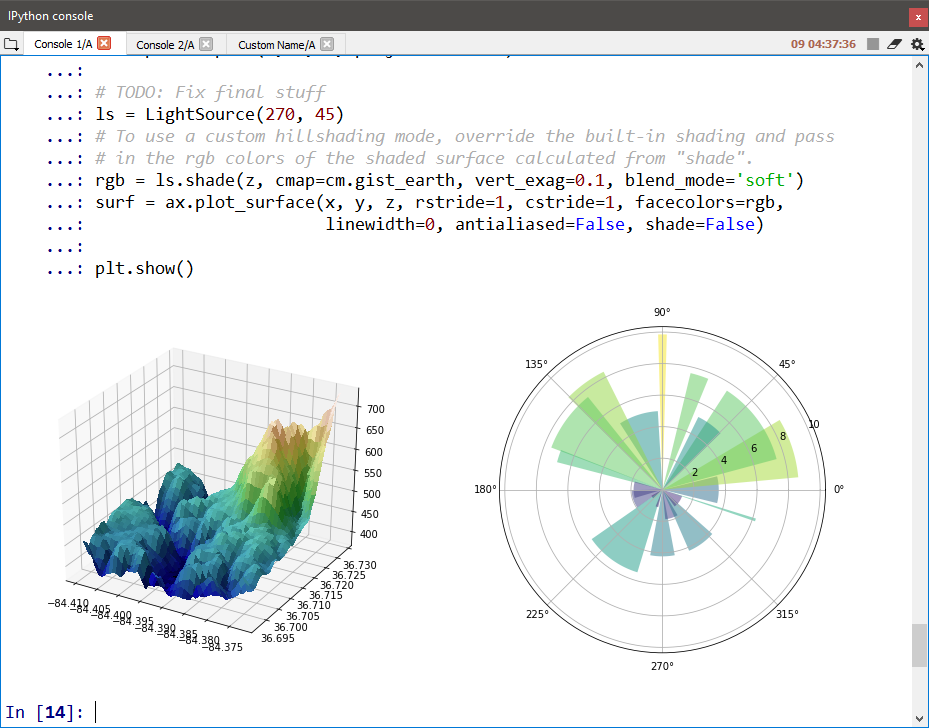
Connecting to a console
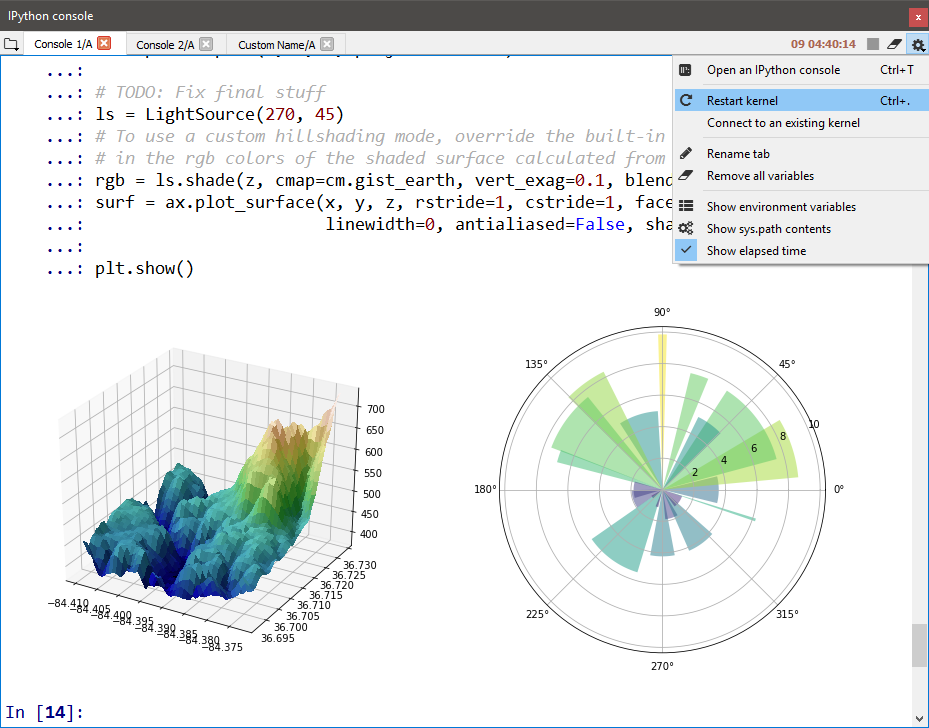
Spyder tin can launch new IPython instances itself, through "Open an IPython panel" nether the Consoles menu, the IPython Console pane menu or its context menu ( Ctrl-T by default), to take advantage of the full suite of Spyder's features. Each console implements a robust two-process IPython session, with a lightweight forepart-end interface connected to a full kernel back stop. Yous can also connect to external local and remote kernels, including those managed by QtConsole sessions or the Jupyter Notebook, through the Connect to an existing kernel dialog under the same menus External kernels still support many (though not all) of Spyder's advanced capabilities.
Connect to an external kernel
Note
If on Windows and connecting to a remote auto over ssh , you'll need to install the paramiko python package first, due east.g. with conda install paramiko if using Anaconda.
To connect to an external kernel,
-
Launch an IPython kernel on the local or remote host if one is not already running.
-
If using Spyder 3.3.0 or afterwards, you'll demand to launch the kernel with
python -m spyder_kernels.panel(after you've first installedspyder-kernelson the host with<conda/pip> install spyder-kernels). -
If using a version of Spyder before 3.3.0,
ipython kernelshould work to launch the kernel, albeit without certain Spyder-specific features.
-
-
Copy the connection file (
jupyter/runtime/dir/path /kernel- pid .json) to the machine you're running Spyder on (if remote) or notation its location (if local).You tin go
jupyter/runtime/dir/pathpast executingjupyter --runtime-dirin the same Python environment equally the kernel. -
Click Connect to an existing kernel from the Console menu or the IPython Panel pane'south "Gear" menu.
-
Browse for or enter the path to the connection file from the previous pace. If you're connecting to a local kernel, click Ok and Spyder should connect to the kernel; if a remote kernel, proceed to the final step.
As a convenience, kernel ID numbers (e.g.
1234) entered in the connection file path field volition be expanded tojupyter/runtime/dir/path /kernal- id .jsonon your local machine. -
If connecting to a remote kernel over
ssh, bank check the appropriate box and type the full hostname yous're connecting to (in the formusername @ hostname : port-number). Then, enter eitherusername'southward password on the remote automobile, or your user SSH keyfile (typically.perm) (only one is needed to connect), and printing Ok.The port number is the one on which the SSH daemon (
sshd) is running, typically 22 unless you lot or your administrator has configured it otherwise.
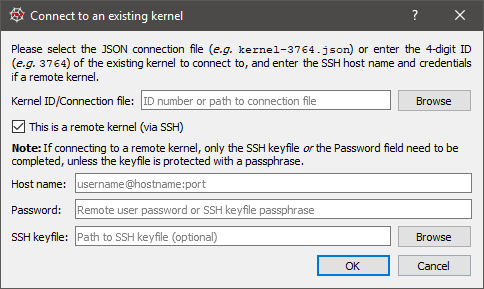
For more technical details virtually connecting to remote IPython kernels, see the Connecting to a remote kernel page in the IPython Cookbook. Only remember to enter the advisable details into Spyder's Connect to an existing kernel dialog instead of launching a new frontend on the client with --existing .
Supported features
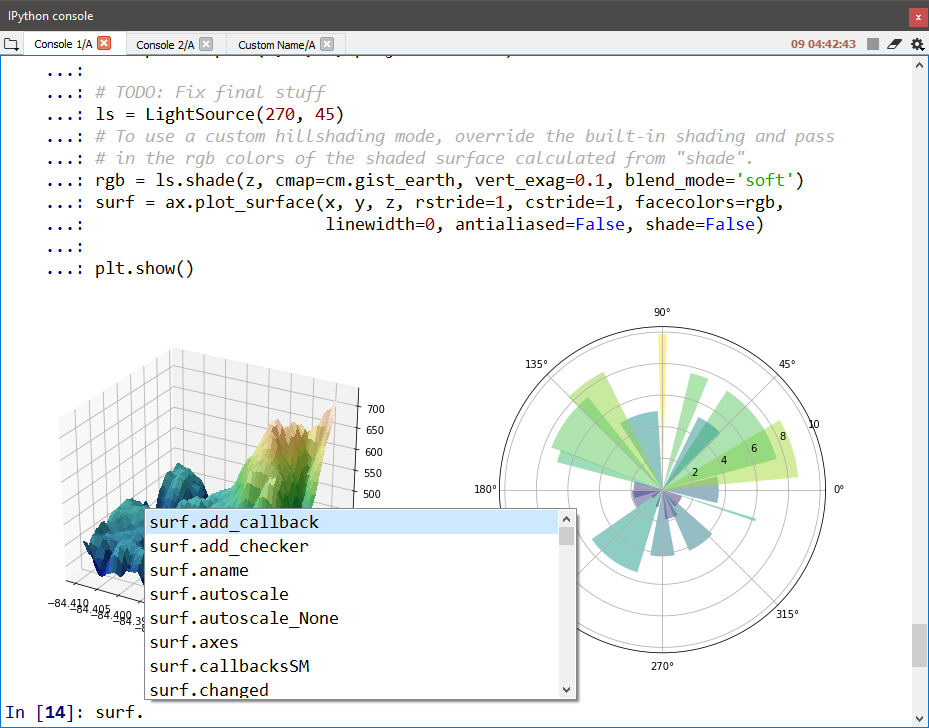
Whatever IPython Console in Spyder, internally or externally created, supports additional features including:
-
Automated code completion
-
Existent-time function calltips
-
Debugging toolbar integration for launching the debugger and controlling execution flow
Spyder-created consoles back up fifty-fifty more advanced capabilities, such as:
-
The Variable Explorer, with GUI-based editors for many built-in and third-party Python objects
-
Full GUI integration with the enhanced IPython debugger,
ipdb, including viewing and setting normal and conditional breakpoints interactively in any file, a Breakpoints pane, and post-obit along with execution menstruum in the in the Editor (meet the Debugging documentation for more than details) -
The User Module Reloader, which can automatically re-import modified packages and files
-
Inline display of Matplotlib graphics, if the
Inlinebackend is selected under
For information on the features, commands and capabilities built into IPython itself, see the IPython documentation.
Using UMR to reload changed modules
When working with scripts and modules in an interactive session, Python but loads a module from its source file once, the first time it is import -ed. During this offset import , the bytecode ( .pyc file) is generated if necessary and the imported module object is cached in sys.modules . If you subsequently re-import the module anytime in the aforementioned session without Spyder, this cached lawmaking object volition be used even if its source code ( .py{w} file) has changed in the meantime. While efficient for final production code, this behavior is frequently undesired when working interactively, such as when analyzing data or testing your ain modules. In outcome, you're left with no manner to update or modify any already-imported modules, aside from manually removing the relevant .pyc files, or restarting the console entirely.
Fortunately, in Spyder, at that place's an easy solution: the User Module Reloader (UMR), a Spyder-exclusive feature that, when enabled, automatically reloads modules right in the existing IPython beat whenever they are modified and re-imported, without whatever of the downsides of the in a higher place workarounds. Even ameliorate, Spyder also loads the %autoreload magic by default into whatever kernels it starts, assuasive changes in already imported modules to be automatically picked upwards the as soon equally the modified file is saved, without any additional user action. With UMR enabled, you can exam circuitous applications within the aforementioned IPython interpreter without having to restart information technology every time you make a change, saving big amounts of transmission tedium and long restart times. Or, if you lot're analyzing data step past step using your own custom libraries, you tin easily add or tweak a office in the latter and encounter the results reflected in the former, all without the overhead of reloading the information and re-running your whole script to restore your session to the same point.
UMR is enabled by default, and will practise its work automatically without user intervention, although information technology volition provide yous with a blood-red Reloaded modules: message in the console list the files it has refreshed when it activates. If desired, y'all tin can plough it and the message on or off, and prevent specific modules from being reloaded, under .
Source: https://docs.spyder-ide.org/3/ipythonconsole.html

Post a Comment for "No Ipython Console Is Currently Available to Run Pysample. Please Open a New One and Try Again."