Draw a Diagram Illustrating the Process of Natural Selection
Yardost educated people in Europe and the Americas during the 19th century had their offset full exposure to the concept of evolution through the writings of Charles Darwin  . Conspicuously, he did not invent the thought. That happened long before he was born. Yet, he carried out the necessary research to conclusively certificate that development has occurred and then made the idea acceptable for scientists and the general public. This was not piece of cake since the idea of evolution had been strongly associated with radical scientific and political views coming out of postal service-revolutionary France. These ideas were widely considered to exist a threat to the established social and political order.
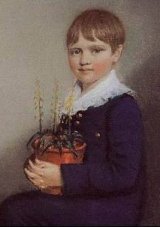 | |
| Charles Darwin at age 7 |
Charles Darwin was born into a moderately wealthy family in Shrewsbury, England. His male parent, Robert, had the largest medical exercise outside of London at the time and his mother, Susannah Wedgwood, was from a family of wealthy pottery manufacturers. She died when Charles was but 8 years former. Thereafter, he was raised mostly by his father and doting older sisters. Charles grew up in comparative luxury in a large house with servants. However, this was a socially conservative time in England that fix narrow limits on a young human'southward behavior and future possibilities. The constraints on women in Darwin'southward social class were even greater. Most were given only enough education to efficiently manage the homes of their future husbands and raise their children. Young men were expected to go to academy in lodge to prepare themselves to become medical doctors, military officers, or clerics in the Church of England. Almost other occupations were considered somewhat unsavory.
At his father's direction, Charles Darwin started university at 16 in Edinburgh, Scotland as a medical pupil. He showed trivial bookish interest in medicine and was revolted by the brutality of surgery being performed without hurting relief. Anesthesia was non used for operations until 1842. Darwin dropped out of medical school after two years of study in 1827. Still, his knowledge of natural history was incidentally enriched in Edinburgh past the teaching of Robert Grant, a noted professor of beefcake and an avid marine biologist. At Grant's suggestion, Darwin as well became a member of Plinian Society for student naturalists at the Academy of Edinburgh.
Having given up on a medicine as a time to come career, Charles Darwin'south father and so sent him to Cambridge University in 1828 to pursue an ordinary degree programme with the goal of later becoming an Anglican parson. In Cambridge his life's management continued its radical change. He became very interested in the scientific ideas of the geologist Adam Sedgwick and the naturalist John Henslow with whom he spent considerable time collecting specimens from the countryside around the university. At this time in his life, Darwin apparently rejected the concept of biological evolution, just as his mentors Sedgwick and Henslow did. However, Darwin had been exposed to the ideas of Lamarck about evolution earlier while he was a educatee in Edinburgh.
| | |
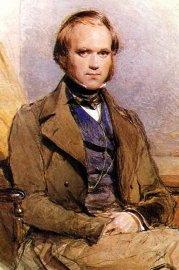
| Charles Darwin |
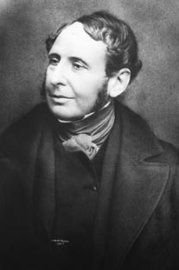 | |
| Helm Robert Fitzroy |
Post-obit graduation from Cambridge in 1831 with a Bachelor of Arts degree, Darwin was clearly more interested in biology and geology than he was in a clerical career. Fortunately, John Henslow was able to help him secure a booth on a British Navy mapping expedition that was going effectually the world on what would ultimately go a nearly five year long voyage. Initially, Darwin'southward male parent refused to let him to go but was eventually persuaded by Charles and even agreed to pay for his passage and for that of his man servant on the journey. They sailed two days after Christmas in 1831 aboard the survey send H.Thou.S. Beagle with Darwin acting as an unpaid naturalist and gentleman companion for the aloof helm, Robert Fitzroy. Darwin was 22 years old at the time, and Fitzroy was only four years older. The Beagle was a compact xc pes long ship with a crew of 74. There was piffling space, even for the captain. Darwin shared a cramped ten X 11 foot cabin with two other men, a cabin boy, and their belongings. Because of the Beagle'southward design and small size, it was generally thought by naval men that it was ill suited for the rough seas it would run into, peculiarly at the southern tip of S America. Darwin frequently suffered from sea sickness on the voyage. Fortunately, he was able to spend most of the time on country exploring. In fact, he was at sea for only 18 months during the nearly five years of the expedition.
Captain Fitzroy was interested in advancing scientific discipline and was peculiarly drawn to geology. He had a surprisingly skillful library of over 400 books onboard the Beagle that he made bachelor to Darwin. It was during the first of the voyage that Darwin read the beginning volumes of Charles Lyell's "Principles of Geology" and became convinced by his proof that uniformitarianism provided the correct agreement of the earth'south geological history. This intellectual preparation, along with his research on the voyage, was disquisitional in leading Darwin to later accept evolution. Especially of import was his 5 weeks long visit to the Gal�pagos Islands in the Eastern Pacific Sea. Information technology was there that he made the observations that eventually led him to comprehend what causes plants and animals to evolve, but he evidently did non clearly codify his views on this until 1837. At the time he left the Gal�pagos Islands, he evidently withal believed in a traditional Biblical cosmos of all life forms.
The Gal�pagos Islands have species constitute in no other part of the world, though similar ones exist on the westward coast of South America. Darwin was struck by the fact that the birds were slightly different from i island to another. He realized that the key to why this difference existed was continued with the fact that the diverse species live in unlike kinds of environments.

On returning to England, Darwin and an ornithologist associate identified 13 species of finches that he had collected on the Gal�pagos Islands. This was puzzling since he knew of just i species of this bird on the mainland of Southward America, most 600 miles to the east, where they had all presumably originated. He observed that the Gal�pagos species differed from each other in neb size and shape. He as well noted that the beak varieties were associated with diets based on different foods. He ended that when the original Due south American finches reached the islands, they dispersed to dissimilar environments where they had to adapt to different conditions. Over many generations, they changed anatomically in ways that allowed them to go enough nutrient and survive to reproduce. This observation was verified by intensive field research in the last quarter of the 20th century.
Today we apply the term adaptive radiation to refer to this sort of branching evolution in which different populations of a species become reproductively isolated from each other by adapting to unlike ecological niches and somewhen become separate species.
Darwin came to sympathise that any population consists of individuals that are all slightly different from one another. Those individuals having a variation that gives them an advantage in staying alive long plenty to successfully reproduce are the ones that pass on their traits more frequently to the side by side generation. After, their traits become more mutual and the population evolves. Darwin chosen this "descent with modification."
The Gal�pagos finches provide an excellent example of this process. Amidst the birds that ended upwardly in arid environments, the ones with beaks better suited for eating cactus got more than food. As a outcome, they were in better condition to mate. Similarly, those with beak shapes that were better suited to getting nectar from flowers or eating hard seeds in other environments were at an reward there. In a very real sense, nature selected the best adapted varieties to survive and to reproduce. This process has come to be known every bit natural selection .
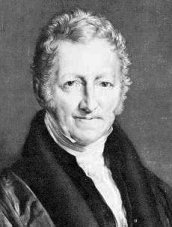 | |
| Thomas Malthus |
Darwin did non believe that the surround was producing the variation within the finch populations. He correctly thought that the variation already existed and that nature just selected for the most suitable beak shape and against less useful ones. By the late 1860's, Darwin came to describe this process equally the "survival of the fittest." This is very different from Lamarck's incorrect idea that the environment altered the shape of individuals and that these acquired changes were then inherited.
Nineteenth century critics of Darwin thought that he had misinterpreted the Gal�pagos finch data. They said that God had created the 13 different species equally they are and that no evolution in bill shape has always occurred. Information technology was difficult to conclusively refute such counter arguments at that time. All the same, extensive field research since the early 1970'south has proven Darwin to exist correct.
In 1798, Thomas Malthus , an English language clergyman and pioneer economist, published Essay on the Principles of Population. In it he observed that human populations will double every 25 years unless they are kept in check by limits in food supply. In 1838, Darwin read Malthus' essay and came to realize that all establish and creature populations take this same potential to rapidly increment their numbers unless they are constantly kept in check by predators, diseases, and limitations in nutrient, water, and other resource that are essential for survival. This fact was fundamental to his understanding of the process of natural selection. Darwin realized that the most fit individuals in a population are the ones that are to the lowest degree probable to dice of starvation and, therefore, are well-nigh likely to pass on their traits to the next generation.
 Who Was Charles Darwin?--video clip from PBS 2001 series Evolution
requires RealPlayer to view (length = 6 mins, 26 secs)
An example of development resulting from natural choice was discovered amongst "brindled" moths living nearly English language industrial cities. These insects have varieties that vary in wing and body coloration from low-cal to night. During the 19th century, sooty fume from coal burning furnaces killed the lichen on copse and darkened the bark. When moths landed on these trees and other blackened surfaces, the dark colored ones were harder to spot past birds who ate them and, after, they more often lived long enough to reproduce. Over generations, the surround continued to favor darker moths. As a issue, they progressively became more mutual. By 1895, 98% of the moths in the vicinity of English language cities like Manchester were by and large black. Since the 1950's, air pollution controls have significantly reduced the amount of heavy particulate air pollutants reaching the copse, buildings, and other objects in the environment. As a effect, lichen has grown dorsum, making trees lighter in colour. In addition, once blackened buildings were cleaned making them lighter in color. Now, natural choice favors lighter moth varieties and then they have become the virtually common. This trend has been well documented by field studies undertaken betwixt 1959 and 1995 past Sir Cyril Clarke from the Academy of Liverpool. The same pattern of moth wing colour evolutionary change in response to increased and later decreased air pollution has been carefully documented by other researchers for the countryside around Detroit, Michigan. While it is abundantly clear that at that place has been an evolution in brindled moth coloration due to the advantage of camouflage over the last 2 centuries, i t is important to keep in mind that this story of natural selection in action is incomplete. There may accept been additional natural pick factors involved.
| Dark moths on low-cal colored bark are |
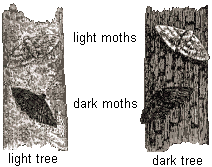
Darwin'due south use of the phrase "survival of the fittest" is frequently misunderstood. Many people presume that "the fittest" refers to the strongest, biggest, or smartest and most cunning individuals. This may or may not be the case. From an evolutionary perspective, the fittest individuals are simply the ones who have the combination of traits that let them to survive and produce more offspring that in turn survive to reproduce. In fact, they may exist relatively weak, minor, and non particularly intelligent. What makes an private fit all depends on the surround at the time and the combination of traits that are nigh suited to flourishing in it. In the case of Darwin's finches, specialized beaks provided the reward. All the same, in a irresolute environment, it is oft the versatile generalist who has the greatest success.
Darwin did not believe that development follows a predetermined direction or that it has an inevitable goal. His explanation that evolution occurs every bit a result of natural selection implied that hazard plays a major role. He understood that information technology is a matter of luck whether whatever individuals in a population have variations that will allow them to survive and reproduce. If no such variations exist, the population rapidly goes extinct considering it cannot adapt to a changing surroundings. Unlike Lamarck, Darwin did not believe that development inevitably produces more circuitous life forms and that the ultimate event of this procedure is humans. These were shocking, revolutionary ideas even for scientists who accepted evolution.
Darwin did not rush his ideas about evolution and natural selection into print. He starting time concentrated his efforts on writing the account of his around the world voyage on the Beagle and analyzing the many preserved animal and plant specimens and all-encompassing notes that he brought back with him. This occupied him for more than 10 years. An additional factor that may accept held him back from publishing his ideas about evolution was the widespread Christian evangelical fervor in England during the 1830'southward and 1840's. He could have been charged with sedition and blasphemy for widely publishing his unpopular theory.
Later on returning from the voyage of the Beagle, Darwin settled down in England, married Emma Wedgwood (his wealthy first cousin), raised a big family, and quietly continued his enquiry at his newly purchased country home 16 miles south of London. In 1842 he wrote a 35 page summary of his theory near evolution. This was expanded to a 230 folio manuscript in 1844, but it was not published and apparently was only known to a few people in British scientific circles. Darwin busied himself over the next two decades establishing his reputation every bit an of import naturalist by growing and studying orchids, pigeons, earthworms, and other organisms at his abode. He spent viii of these years studying and writing nearly barnacles that people had sent him from around the earth.
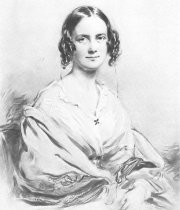 | 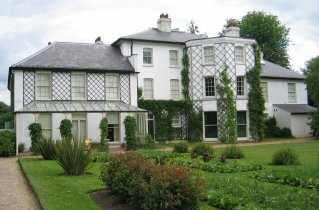 | 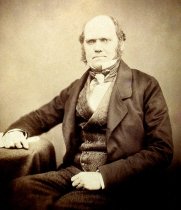 | ||
| Emma Darwin | Downwards House--Charles and Emma Darwin's country home where he wrote his major publications and their family lived contentedly for 40 years. | Charles Darwin |
Information technology was not until he was 50 years erstwhile, in 1859, that Darwin finally published his theory of evolution in full for his beau scientists and for the public at big. He did so in a 490 page book entitled On the Origin of Species. It was very popular and controversial from the outset. The first edition came out on Nov 24, 1859 and sold out on that day. It went through six editions past 1872. The ideas presented in this volume were expanded with examples in fifteen additional scientific books that Darwin published over the next two decades.
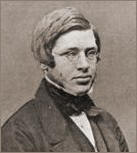 | |
| Alfred Wallace 1823-1913 |
What finally convinced Darwin that he should publish his theory in a volume for the full general educated public was the draft of an essay that he received in the summertime of 1858 from a younger British naturalist named Alfred Wallace , who was then hard at piece of work collecting biological specimens in Southeast Asia for sale to museums and private collectors. Darwin was surprised to read that Wallace had come upon essentially the same explanation for evolution. Being a off-white human, Darwin insisted that Wallace also become credit for the natural selection theory during debates over its validity that occurred at a meeting of the British Clan for the Advocacy of Science at Oxford University in 1860. We now know that Darwin deserves most of the credit. In 1837, one yr after he returned from the voyage on the Beagle, he fabricated detailed notes on the idea of evolution by means of natural selection. At that time, Wallace was just 14 years one-time. In addition, it was Darwin's volume, rather than Wallace'south essay, that had the most touch on the Victorian public. Darwin not only described the process of natural choice in more detail, simply he also gave numerous examples of it. It was his On the Origin of Species that convinced well-nigh scientists and other educated people in the late 19th century that life forms do change through time. This prepared the public for the acceptance of before homo species and of a world much older than 6000 years.
Darwin and Victorian Culture--interview with Darwin'south biographer, James Moore
This link takes you to an audio file at an external website. To return hither, y'all must click
the "dorsum" push on your browser program. (length = 8 mins, five secs)
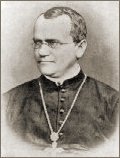 | |
| Gregor Mendel 1822-1884 |
Both Darwin and Wallace failed to understand an of import aspect of natural option. They realized that found and creature populations are composed of individuals that vary from each other in physical form. They also understood that nature selects from the existing varieties those traits that are most suited to their surround. If natural pick were the merely process occurring, each generation should have less variation until all members of a population are substantially identical, or clones of each other. That does not happen. Each new generation has new variations. Darwin was aware of this fact, simply he did not sympathize what acquired the variation. The beginning person to brainstorm to grasp why this happens was an obscure Central European monk named Gregor Mendel . Through plant breeding experiments carried out betwixt 1856 and 1863, he discovered that in that location is a recombination of parental traits in offspring. Sadly, Darwin and almost other 19th century biologists never knew of Mendel and his inquiry. It was not until the offset of the 20th century that Mendel'due south pioneer research into genetic inheritance was rediscovered. This was long later his death. He never received the public acclaim that was eventually showered on Darwin during his lifetime.
Charles Darwin's convincing evidence that development occurs was very threatening to many Christians who believed that people were created specially by God and that they accept non inverse biologically since that creation. The idea that there could accept been prehistoric humans who were anatomically dissimilar from us was rejected for similar reasons. Withal, Charles Lyell'south geological testify that the globe must be much older than 6,000 years forth with the rapidly accumulating fossil record of by evolution convinced educated lay people in the 1860's to call up what had been unthinkable earlier.
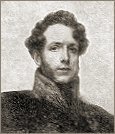 | |
| Boucher de Perthes 1788-1868 |
Archaeological confirmation of the beingness of prehistoric Europeans had been accumulating since the 1830's. However, until the late 1850's, it had been widely rejected or misinterpreted. Much of this evidence had been collected past Jacques Boucher Cr�vecoeur de Perthes , a customs officeholder in northern France during the early 1800'due south. His hobby was collecting ancient rock tools from deep down in the Somme River gravel deposits. Since he constitute these artifacts in association with the bones of extinct animals, he concluded that they must have been made at the fourth dimension that those animals lived.
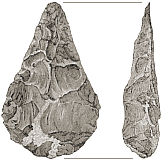 | |
| Prehistoric artifact incorrectly thought to be a "lightning bolt remnant" |
Boucher de Perthes tried to publish his findings in 1838. They were rejected past all important scientists and scientific journals. The prehistoric stone tools normally were dismissed equally being only "lightning stones" (i.e., the remnants of lightning bolts). However, past 1858, his claims were beginning to be accepted by some enlightened Western European scientists. Darwin's publication of On the Origin of Species the post-obit yr convinced fifty-fifty more educated people that Boucher de Perthes had been right.
Darwin's popularizing the thought of evolution also made information technology possible for scientists to begin to accept that some of the makers of Boucher de Perthes' prehistoric tools had already been discovered and that their bones were in museums. These basic had been found in several Western European countries during the first half of the 19th century. However, they had all been dismissed as being from odd looking modern people. During the 1860'due south, some were correctly determined to be from an earlier species or variety of people who had lived during the last ice age--i.e., long before recorded history. Nosotros now know that these ancient people were mostly Neandertals, who lived about 150,000-28,000 years ago.
NOTE : Charles Darwin was an agile collector of plant and animal specimens and a prodigious note taker on the voyage of H.M.Southward. Beagle. By the time the ship returned to England in 1836, he had accumulated five,436 plant and animal specimens that had been dried or preserved in booze. He had 368 pages of notes on plants and animals too as 1,383 pages of geological observations. In addition, he had a 770 page diary that was the basis for his subsequently popular book of his narrative on the voyage ( " Journal of Researches Into the Natural History and Geology of the Countries Visited During the Voyage of H.One thousand.South. Beagle Round the World, Nether the Control of Capt. Fitz Roy, R.Due north. " ) .
Annotation : From the time that Charles Darwin published "On the Origin of Species" in 1859 on up to the present, the presumptions of many people led them to misread the title. They assumed that information technology was "On the Origin of the Species". The implication of inadvertently adding "the" is that his volume was about human development. In fact, that was not the example, though it had implications for man development. It focused on non-man animals and the mechanisms of evolution. He did not pointedly address the question of human evolution until the publication of his 1871 book "Descent of Homo and Selection in Relation to Sex".
Note : The phrase "survival of the fittest" was apparently commencement used in 1851 by the influential British philosopher Herbert Spencer (1820-1903) equally a central tenet of what subsequently became known every bit "Social Darwinism." He misapplied Darwin'due south idea of natural pick to justify European domination and colonization of much of the rest of the world. Social Darwinism was also widely used to defend the unequal distribution of wealth and ability in Europe and North America at the fourth dimension. Poor and politically powerless people were thought to take been failures in the natural contest for survival. Subsequently, helping them was seen as a waste product of time and counter to nature. From this perspective, rich and powerful people did not need to experience ashamed of their advantages because their success was proof that they were the most fit in this competition. Despite misgivings by Alfred Wallace and other naturalists, Charles Darwin began to utilize "survival of the fittest" as a synonym for "natural selection" in the 5th edition of Origin of Species, which was published in 1869.
Note : H.1000.South. Beagle, the famous ship that took Charles Darwin on his 1831-1836 voyage around the world, had a rather mundane history following her render to England. She was transferred by the British Navy to the Community and Excise Department and was used to grab smugglers along the southeast coast of England. The Beagle was finally sold for scrap in 1870 afterward l years of service.
Copyright � 1998-2013 by Dennis O'Neil . All rights reserved.
illustration credits
Source: https://www2.palomar.edu/anthro/evolve/evolve_2.htm

Post a Comment for "Draw a Diagram Illustrating the Process of Natural Selection"