Where to Put an Apostrophe When a Name Ends in S
Charles' or Charles's? Harris' or Harris's? Possessives of Names Ending in S
Summary
The possessive of a name ending in s can be formed by adding only an apostrophe or an apostrophe and another s. Style manuals differ in their recommendations. The Chicago Manual of Style and APA Publication Manual recommend an additional s after the apostrophe.
Examples
- Charles's house has red walls and a white door.
- What are Kamala Harris's views on health care?
- I found James's shoes in the snow.
Other style guides, such as the AP Stylebook, suggest adding only the apostrophe.
Examples
- Charles' house
- Kamala Harris' views on health care
- James' shoes
For plural possessives of such names, always insert the apostrophe after the final s.
Examples
- the Harrises' house
- the Joneses' cat
Add an apostrophe and s to form possessives of names ending in x and z.
Examples
- Marx's philosophy
- Gomez's voice
To form possessives of plural names of countries, don't add another s, just an apostrophe.
Examples
- the United States' jazz culture
- the Seychelles' seashells
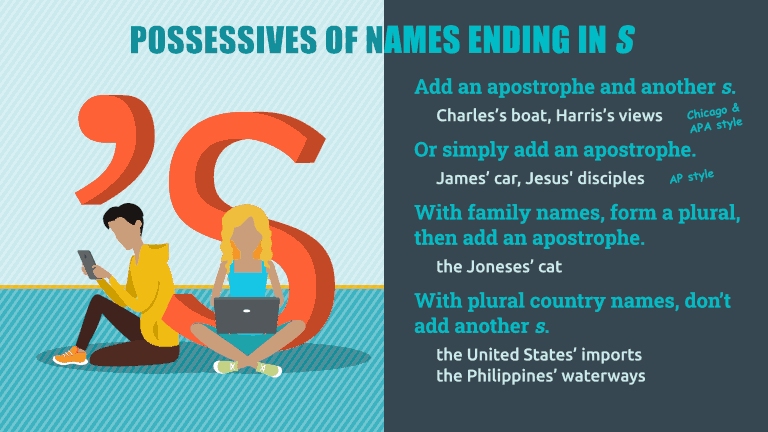
How to form a possessive
To form the possessive of a noun, including a name, the general rule is to add an apostrophe and s.
Examples
- Anita's books
- Austria's capital
- A cat's whiskers
But what do you do if a name already ends in s: Charles's boat or Charles' boat? In this article, we discuss how to form the possessives of names ending in s, like James, Harris, Charles, and Dickens.
Possessives of names ending in s
To form the possessive of a name like Charles, James, or Harris, add either an apostrophe and an s or just the apostrophe. Both styles are acceptable in formal writing.
Examples
- We borrowed Charles's boat, James's house, and Harris's car for our vacation.
- We borrowed Charles' boat, James' house, and Harris' car for our vacation.
or

Style guides differ in their recommendations, as discussed below.
Just the apostrophe
One accepted way to form the possessive of a name that already ends in s, like Charles or James, is to simply tack on an apostrophe (like you would with plural nouns).
Examples
- Charles' boat
- James' house
- Jesus' teachings
- Agnes' books
- Chris' computer
- Charles Dickens' novels
- Kamala Harris' education
This kind of usage is quite common. For instance, the AP Stylebook recommends this style, as do others, if only for its simplicity.
Apostrophe and another s
Another accepted way to form the possessive of a name ending in s is to treat it like any other name. Add an apostrophe as well as an additional s: Charles's, Harris's, James's.
Examples
- We rented Charles's house for the summer.
- Have you seen James's new boat?
- Jesus's return to Galilee is written about in the Gospel of John.
- Anita's and Agnes's books are on the table.
- Chris's computer isn't working.
- Is this Charles Dickens's house?
- What are Kamala Harris's views on immigration?
The Chicago Manual of Style and APA Publication Manual recommend this style, consistent with how possessives in general are formed.
Additional s only if pronounced
Some writers add another s after the apostrophe in writing only if the additional letter would actually be pronounced while speaking. For example, many people pronounce the possessive of Chris, Jesus, and Dickens without an extra s sound.
Examples
- Chris' computer isn't working.
- Jesus' return to Galilee is written about in the Gospel of John.
- We visited Charles Dickens' house in London.
- Ares' numerous offspring are often alluded to in Greek mythology.
But many people do add an additional s sound to form possessives of names like Harris and Dennis.
Examples
- Harris's sister is a political analyst.
- Jonas's bag is lost.
- I met Dennis's editor in Amsterdam.
Possessives of plural names
Family names (like Jones) are pluralized to refer to more than one person. To form the plural, add an s or es: the Smiths, the Dalys, the Patels, the Dickenses, the Joneses, the Harrises. Then, to form the possessive of this plural, simply add an apostrophe after the s, as you would for any other plural word.
Examples
- the Patels' cats
- the Dalys' rats
- the Harrises' bats
- the Joneses' hats
Caution
Be careful about where you insert the apostrophe.
Example
- Nick Jones' hat or Nick Jones's hat
but
the Joneses' hats
Since "Joneses" is the plural of "Jones," the apostrophe must always follow the final s.
Example
- Incorrect: the Jones' hats
Incorrect: the Jones's hats
Incorrect: the Jonese's hats
Correct: the Joneses' hatsTo refer to the entire family, form the plural by adding es, and then add an apostrophe for the possessive.
Possessives of names ending in a silent s
As with most possessives, you can add an apostrophe and an additional s to names that end in a silent, unpronounced s. The Chicago Manual of Style, for example, recommends this style.
In contrast, other style manuals, such as the APA Publication Manual and the AP Stylebook, suggest adding only an apostrophe (and no additional s).
Examples
- Camus' novels
- Arkansas' capital
Possessives of names ending in x or z
Possessives of names ending in sibilant sounds like x or z are formed as usual: by adding an apostrophe and an s. This is the style recommended by major style guides like the Chicago Manual of Style and AP Stylebook.
Examples
- Marx's theories
- Rex's letters
- Diaz's hairstyle
- Lopez's books
Note
Some writers prefer to form the possessive of a name ending in x or z by adding only an apostrophe, since the name already ends in a sibilant sound. However, using an additional s is preferred in most formal styles.
Possessives of names of countries and other places
The possessive of a place name is usually formed by adding an apostrophe and an s (as with any other name).
Examples
- Nepal's mountain ranges
- France's vineyards
To form the possessive of a country or place name that already ends in s, follow the same rules as those for people's names.
Examples
- James' mother is a member of Texas' senate.
or
James's mother is a member of Texas's senate.Either style is fine, as long as you stay consistent.
However, if a place or country name is plural, simply add an apostrophe at the end (without an additional s).
Examples
- the United States' relationship with China
- the Philippines' music industry
Caution
Never add an additional s to form the possessive of a place name that is plural, regardless of which style guide you follow.
Example
- Incorrect: the United States's representatives
Correct: the United States' representatives
Usage guide
For names ending in s, form the possessive either by simply adding an apostrophe (James' books) or by adding an apostrophe another s (Charles's phone). The possessive of a plural name is always formed by adding an apostrophe after the final s (the Smiths' dog, the Harrises' family home). Form the possessive of a plural place name by adding only an apostrophe (the United States' land area).
Where to Put an Apostrophe When a Name Ends in S
Source: https://editorsmanual.com/articles/possessives-of-names-ending-in-s/

Post a Comment for "Where to Put an Apostrophe When a Name Ends in S"